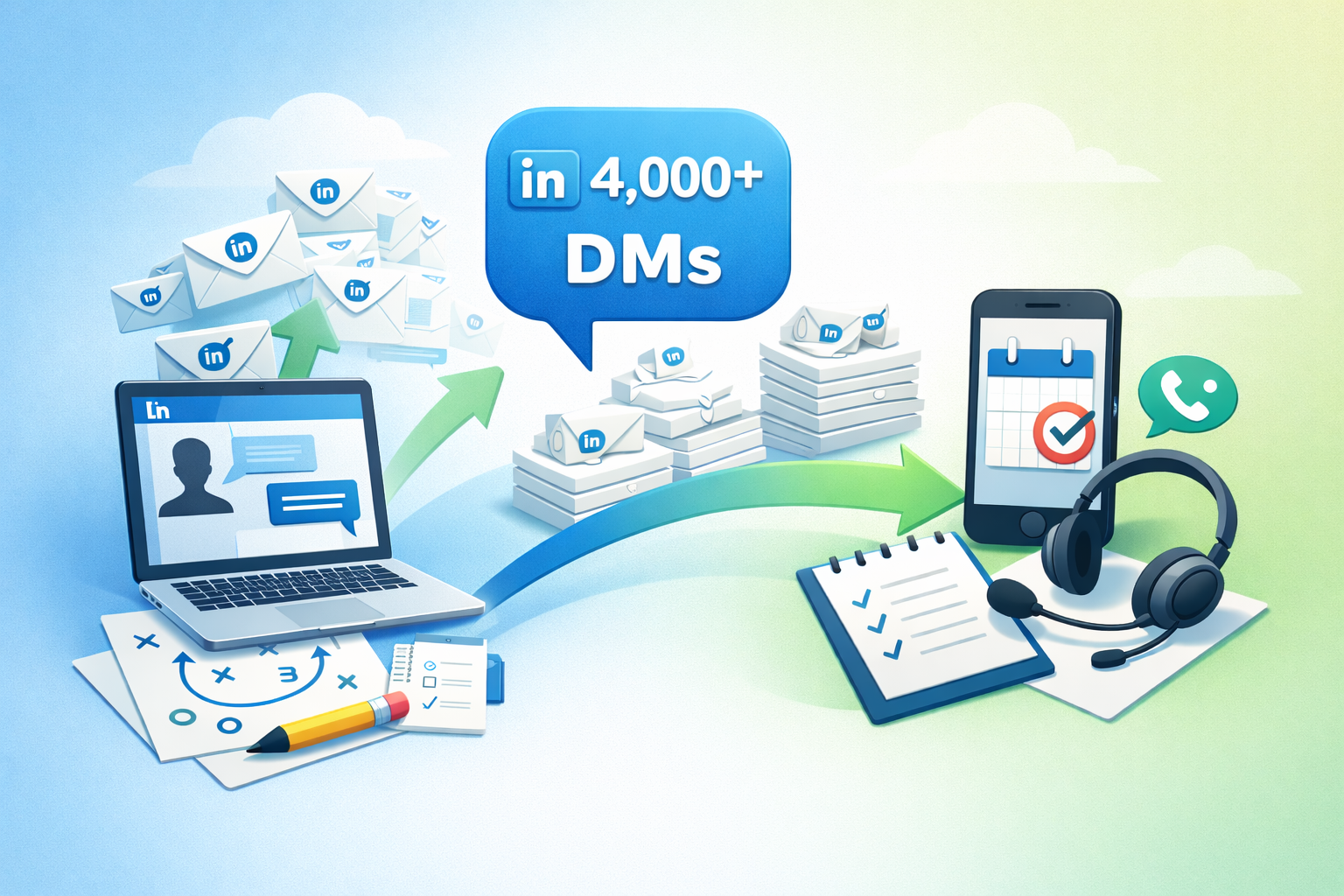
Sending 4,000+ LinkedIn DMs per month is not hard.
Doing it without getting restricted, burning accounts, or filling your calendar with unqualified time wasters is what separates amateurs from operators.
This playbook is the exact framework we use to scale LinkedIn outbound volume while keeping reply quality high and consistently converting conversations into booked, qualified calls.
No fluff. Just the system.
The core idea
High-volume LinkedIn outbound is not a “DM script” problem.
It is a systems problem.
You need 4 things working together:
- Account infrastructure that survives volume
- Targeting that makes replies easy
- Messaging that creates natural conversations
- A setter process that turns replies into booked calls
Most people only focus on the message.
That is why they get restricted, ignored, or stuck with low quality calls.
Part 1: Infrastructure that lets you scale volume safely
1) Multi-account setup (the only real way to scale)
One LinkedIn account is a bottleneck.
If you want 4,000 DMs per month consistently, you need multiple warmed accounts operating under strict daily limits.
Why multi-account works:
- It spreads risk
- It spreads volume
- It lets you scale without pushing any single account too hard
2) Device and IP hygiene (do not wing this)
High volume plus sloppy setup equals restrictions.
Keep it simple:
- One clean environment per account
- Consistent login behavior
- No constant switching devices
- No weird activity spikes
Your goal is to look boring and consistent.
LinkedIn punishes weird.
3) Warming is non-negotiable
New accounts cannot behave like mature accounts.
Warming checklist:
- Build a real profile (banner, headline, about, experience)
- Post or engage a little (basic human activity)
- Grow connections gradually
- Slowly increase daily actions over time
If you want to scale fast, the warming stage is where most people fail.
4) Action limits (rules your team must follow)
Pick conservative caps and enforce them.
A good baseline rule:
- Start low
- Increase slowly
- Never spike suddenly
Consistency beats aggression.
Part 2: The math behind 4,000 DMs per month
Here is the simplest way to think about it.
4,000 DMs per month is roughly:
- 133 DMs per day (if you work 30 days)
- 200 DMs per weekday (if you work 20 days)
You do not hit that safely on one account.
Instead, you distribute it.
Example distribution
- 10 accounts
- 20 DMs per account per day
- 20 working days per month
10 x 20 x 20 = 4,000 DMs per month
This is the entire secret.
Scale by adding accounts, not by abusing one.
Part 3: Targeting that makes replies inevitable
High volume does not fix bad targeting.
If your list is wrong, you are just spamming faster.
The “Perfect Fit” targeting filter
Only message people who match these 4:
- They can buy (budget, size, maturity)
- They have the problem (clear use case)
- They can decide (or influence strongly)
- They are reachable (active on LinkedIn, not ghost profiles)
If your team cannot explain why a lead is a fit in one sentence, they should not message them.
The simple ICP fields you need
- Industry
- Company size range
- Revenue range (optional)
- Geography/time zone
- Job titles to target
- Buying trigger signals (hiring, funding, growth, new offers, new GTM motion)
The highest reply rates come from one thing: relevance.
Part 4: The messaging framework that scales without sounding automated
Your opener has one job:
Start a normal conversation.
It is not supposed to close the deal.
It is not supposed to pitch your whole service.
The 3 rules of high-performing openers
- One idea per message
- Short enough to read instantly
- About them, not you
5 opener templates that work at volume
1) The direct relevance opener
“Hey [Name], quick one, are you still handling [outcome area] at [Company]?”
2) The simple observation opener
“Noticed you’re growing the team at [Company]. Curious, are you building pipeline mostly through outbound or inbound right now?”
3) The outcome question opener
“If you could wave a magic wand and fix one thing in your acquisition this quarter, what would it be?”
4) The permission-based opener
“Mind if I ask a quick question about how you’re generating demos at [Company]?”
5) The micro-context opener
“Hey [Name], I work with a few [industry] teams on LinkedIn pipeline. Are you open to a quick idea that’s been working well lately?”
Pick one framework and stick to it.
Consistency lets your team improve faster.
Part 5: The follow-up system (where most meetings come from)
Most booked calls do not happen on message one.
They happen because you followed up like a human.
The “no cringe” follow-up rule
Every follow-up must add something new:
- a question
- a mini insight
- a micro-example
- a clarification
Never send:
“Just following up”
Follow-up sequence (simple and effective)
Day 1, follow-up #1
“Meant in context of [outcome]. Are you the right person to chat about this, or someone else?”
Day 3, follow-up #2
“Curious, what are you doing today for [pipeline/lead gen]?”
Day 6, follow-up #3
“If I send a 60-second example of what this would look like for [Company], would you be open to it?”
Day 10, follow-up #4 (breakup)
“All good if this isn’t a priority. Should I close the loop?”
That last message gets replies because it is respectful and gives them an easy out.
Part 6: Turning replies into qualified calls (the setter process)
High volume creates replies.
Setters create pipeline.
Here is the playbook your DM Setter should run.
Inbox triage (tag every reply)
- Positive
- Question
- Objection
- Wrong person
- Not interested
- Follow up
- Do not contact
The 4-step booking flow
Step 1: Confirm
“Got it. Quick one so I don’t waste your time, what are you trying to improve right now: more calls, better lead quality, or higher close rate?”
Step 2: Micro-example
“Cool. For teams like yours, we usually:
- target [ICP segment]
- use a short opener around [problem]
- qualify before booking anything
Want me to show you a quick 60-second example tailored to [Company]?”
Step 3: Qualify lightly
Only ask what you need:
- “What are you doing today for pipeline?”
- “What’s the biggest bottleneck right now?”
- “If this worked, what would success look like per month?”
- “Is this something you’d want solved in the next 30 to 90 days?”
Step 4: Book with options
“Makes sense. Want to do a quick 15 to 20 mins to map this out? I can do Tue 2pm or Wed 11am your time.”
If they ask for a link, send it. If not, book manually with time options first.
Part 7: The calendar protection layer (stop junk calls and no-shows)
The faster you scale volume, the more you must protect the calendar.
Use a simple booking gate
Add a short form or pre-call questions:
- Role
- Company size
- Main goal
- Current acquisition channel
- Monthly target
This filters out tire kickers.
No-show reduction sequence
- Confirmation right after booking
- Reminder 24 hours before
- Reminder 2 to 3 hours before
- Optional SMS or phone confirmation for higher ticket
Quick confirmation message
“Still good for tomorrow at [time]? I’ll bring a short plan based on what you shared so it’s super practical.”
Part 8: Metrics that tell you exactly what to fix
Track these weekly:
Top of funnel
- DMs sent
- Accept rate (if connecting first)
- Reply rate
- Positive reply rate
Middle
- Booking rate from positive replies
- Qualified rate (booked calls that match ICP)
- Show rate
Bottom
- Close rate
- Revenue per booked call
The “bottleneck diagnosis” cheat sheet
- Low reply rate: targeting or opener problem
- High replies but low bookings: setter process problem
- High bookings but low qualified: qualification rules too loose
- High qualified but low show: confirmation and reminders weak
- High show but low close: sales call problem, not outbound
Do not change everything at once.
Fix one bottleneck per week.
Part 9: The operational SOP (what your team runs daily)
Here is the daily routine for a high-volume operation.
Daily checklist
- Load fresh lead list
- Send DMs across accounts within limits
- Tag every reply
- Respond to positives within 15 to 60 minutes
- Run the 4-step booking flow
- Confirm bookings and reduce no-shows
- Log daily metrics
- Flag edge cases and account health issues
Weekly checklist
- Review metrics
- Identify bottleneck
- Update targeting or messaging
- Re-train setters on common mistakes
- Rotate lead sources if list quality drops
This is what makes 4,000+ DMs per month sustainable.
Common mistakes that get people restricted or waste volume
Avoid these and you will be ahead of 90 percent of teams:
- Scaling one account too hard
- Increasing activity too fast
- Copying and pasting giant paragraphs
- Pitching in the first message
- Not following up
- No qualification rules
- Booking calls with anyone who breathes
- No confirmation system
- No metrics tracking
Closing
If you want 4,000+ DMs per month and qualified calls from LinkedIn, do not obsess over “the perfect script.”
Build the machine:
- multi-account infrastructure
- tight targeting
- simple messaging
- human setter process
- calendar protection
- metric-driven iteration
That is the 2026 playbook.
Copy it. Run it. Improve one bottleneck every week.

What works
From teams who've built it
I’m genuinely impressed. This actually delivered ROI, and I didn’t get burned.

We saw a major shift in results, closed high-ticket deals including an $8k pilot, and booked real appointments even during the holidays.

Our previous agency took six weeks to get qualified calls, and you delivered in five days. You’re moving fast and this is how I like to do business.

Ready to build your engine
Stop chasing leads. Let the system work while you focus on closing deals.